

We’re back with another edition, and honestly, there’s a lot to feel good about this week. Indonesia’s startup ecosystem is showing us what happens when scale meets execution: record-breaking revenues, profitable quarters, and a wave of technological ambition that puts the region on the map.
From AI breakthroughs and sustainable financing to a booming esports economy, the momentum is real. The land-grab phase is over, and the builders focused on depth and real value are stepping into the spotlight.
Let’s dive into this week’s exciting updates.
Stay sharp,
The DailySocial Team
What’s New
Here’s your weekly digest of key updates from Indonesia’s startup ecosystem that are worth a look:
Listed Indonesian F&B group Fore recorded 53.3% year-on-year revenue growth to IDR1.6 trillion in the first nine months of 2026, while EBITDA rose 70.6% to IDR342.2 billion and net profit increased 49.7% to IDR90 billion. Its EBITDA margin improved to 21.4% from 19.3%, alongside more than 70 new Indonesian coffee outlets, exceeding its full-year opening target, with over 55% of additions in Tier 2 and Tier 3 cities. The group now operates 410 stores across Fore Coffee in Indonesia and Singapore and its growing Fore Donut business, highlighting a strategy combining expansion beyond major cities with brand diversification. [Read more]
IDX-listed Bukalapak reported adjusted EBITDA of Rp1 billion (US$55,000) in Q3 2026, with revenue broadly flat year on year at Rp1.6 trillion (US$88 million) and gross profit rising to Rp158 billion from Rp123 billion. Gaming contributed Rp1.4 trillion in quarterly revenue, while Mitra Bukalapak’s revenue fell 6% to Rp160 billion as its shift from a first-party to a third-party intermediary model lowered revenue but improved gross profit. Nine-month revenue reached Rp5.6 trillion, with adjusted EBITDA of Rp11 billion, following the company’s 2025 plan to phase out physical-goods ecommerce in favor of virtual products and digital services. [Read more]
GoTo has launched a freely accessible language model at Bali Tech Week, designed to understand Indonesian alongside Javanese, Sundanese, Balinese, and Batak. Built on Gemma 3 and available through Hugging Face, the model allows startups, businesses, universities, and public institutions to adapt and deploy locally relevant AI without training from scratch. The release extends GoTo’s open-model initiative launched in 2024, supported by Indonesian media and public-sector data, university partnerships, and AI talent development. [Read more]
Indonesian electric motorcycle maker ALVA, through PT Electra Mobilitas Indonesia, has expanded its sustainable trade finance facility with Standard Chartered Indonesia to US$20 million, supporting raw-material and component procurement, manufacturing operations, and business development. The facility builds on a banking partnership established in 2022 and represents trade financing rather than an equity funding round. [Read more]
Circulate Capital has invested an undisclosed amount in Indonesian polyolefin recycler Bumi Baru Plastik (BBP), marking its sixth investment in the country. The funding will help BBP scale recycled polypropylene (PP) and polyethylene (PE) processing capacity fivefold over two years, consolidate operations at its Jonggol site in West Java, expand downstream manufacturing, and strengthen feedstock sourcing through a network of more than 400 collection partners. BBP converts post-consumer and industrial plastic waste into OEM-grade recycled materials for automotive, packaging, and other industrial applications; the expansion is projected to divert or avoid an additional 114,100 metric tonnes of plastic and avoid 435,000 tonnes of CO₂e emissions cumulatively by 2030–31. [Read more]
Indonesia’s esports segment contributed US$432 million in 2025, accounting for 24% of its US$1.8 billion gaming economy—the highest value and share among the five Southeast Asian markets covered by Tencent and Access Partnership’s white paper, launched at WCCE 2026 in Jakarta. By 2030, Indonesia’s esports contribution is projected to exceed twice its 2025 value at US$1 billion, representing 30.3% of a US$3.3 billion domestic gaming economy and supporting more than 139,000 jobs. The outlook reflects broader regional growth, with the five markets’ combined gaming economy projected to rise from US$8.2 billion to US$14.2 billion, and esports expected to be the fastest-growing segment. [Read more]
What’s Exciting
Shifts on the regional stage may also directly influence Indonesia’s startup ecosystem. Here’s a look at the latest developments:
Sea plans Monee listing and AI-first enterprise platform.
Singapore-based Sea Ltd plans to take its financial services arm Monee public and launch Sea Cloud, an AI-first enterprise platform, according to an October 20 internal memo from founder Forrest Li. Formerly known as SeaMoney, Monee provides mobile wallets, payment processing, credit, and banking services across eight markets, including Indonesia, Singapore, and Brazil. Li said a listing would give the business additional resources and room to grow, while noting that Sea’s quarterly revenue had increased more than 80-fold to US$7.8 billion since its New York listing nine years earlier.Antares Ventures surpasses US$50 million at Fund I’s second close.
Singapore-based deep-tech VC firm Antares Ventures announced on October 14 that it secured more than US$50 million in commitments for its debut fund, targeting a US$100 million final close. Backed by family offices, corporate investors, and strategic investors from Southeast Asia, Japan, and Korea, the fund has invested approximately US$27 million across nine companies, including VFlowTech, IONATE, enaDyne, and The ePlane Company, and will continue fundraising while deploying selectively. The milestone comes amid broader Singapore deep-tech funding initiatives, including an additional S$440 million for EDB partnerships with global VC firms and NUS’s S$150 million venture capital program, alongside existing support from SEEDS Capital and SGInnovate.
What’s Next: Indonesia Holds Southeast Asia’s Biggest AI Upside
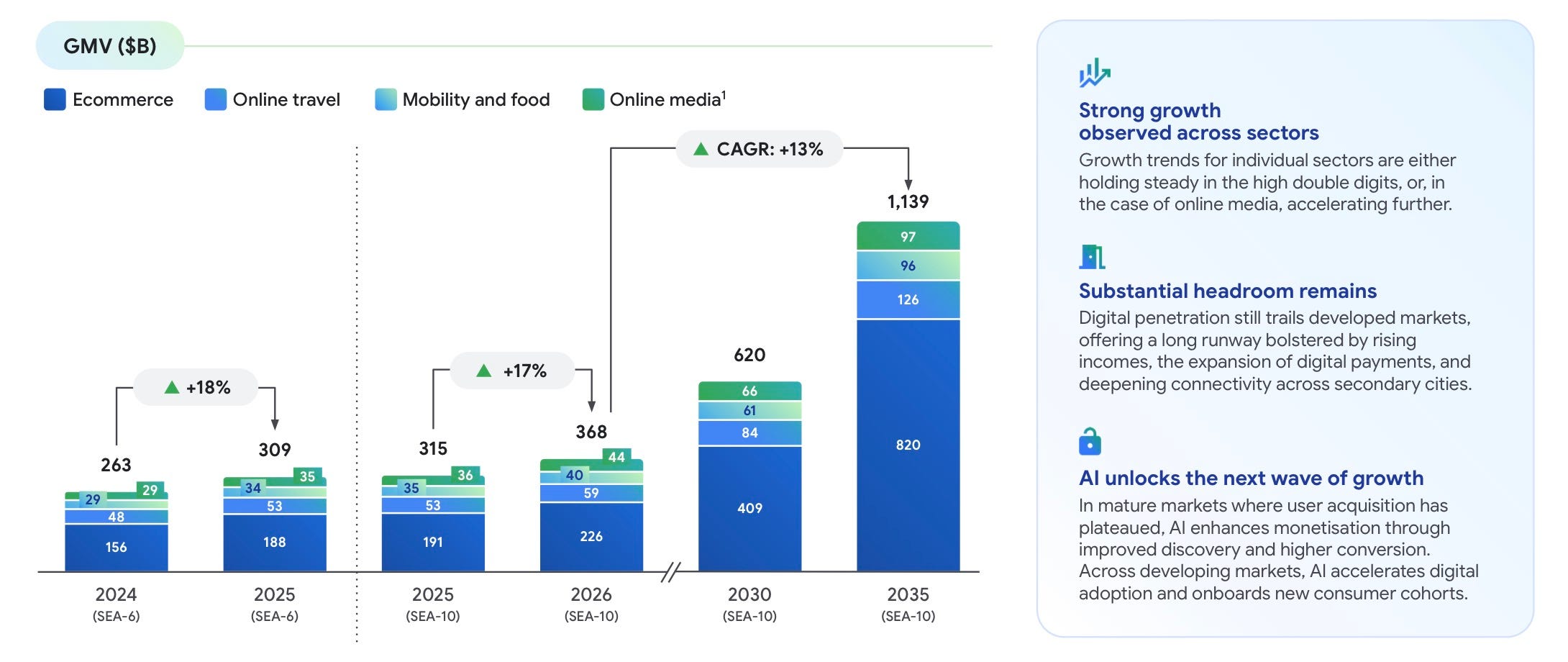
The latest e-Conomy SEA 2026 report from Google, Temasek, and Bain & Company, themed “Building the intelligent economy,“ puts Southeast Asia’s digital economy at US$368 billion in GMV this year, up 17% and on course to cross US$1 trillion by 2035. The bigger story is how fast AI went mainstream: 243 million people across the six major markets, or 58% of the working population, now use GenAI, a penetration level the internet needed over a decade to reach. Indonesia sits at the center of this shift as the region’s largest market with 286 million people, though its GenAI penetration of 54% still trails Singapore (70%) and Malaysia (68%). The report groups Indonesia with the Philippines as the markets with the most headroom for user growth, making it the key battleground for the next adoption wave.
Indonesian AI usage is overwhelmingly consumer-led, with consumer applications accounting for roughly 80-85% of token activity, in contrast to Singapore and Malaysia where enterprise workloads dominate. Creative use is the standout behavior: 32% of Gemini queries in Indonesia involve image generation, around 9 million images per day, the highest volume in Southeast Asia. Monetisation remains early, with only 1-2% of the SEA-6 population paying for GenAI versus 3% of US households, which the report frames as headroom rather than weakness. On the talent side, Komdigi’s AI Talent Factory, targeting 100,000 digital talents annually, is cited among the region’s key upskilling programs.
At the sector level, Indonesia offers the region’s clearest proof that digital models can turn profitable. The country hosts 17 digital banks, the largest field in SEA and home to most of its profitable players, including SeaBank, Bank Jago, and Allo Bank. Their edge comes from acquiring users cheaply through parent platforms and using first-party signals like ecommerce and ride-hailing behavior for underwriting. Regulators are simultaneously reshaping unit economics: an 8% commission cap plus mandatory insurance in ride-hailing, mandatory income checks in digital lending, and POJK 8/2024, which legitimised fully digital insurance policies.
On funding, regional digital economy deals have stabilised at around US$8 billion annually, but the composition has flipped: AI-focused companies captured roughly 80% of private deal value in the last six months, up from about 30% in H2 2024. Indonesia is showing renewed late-stage momentum, highlighted by Ajaib’s US$270 million Series C, while Indonesian application companies were among those tapping public markets again. With GDP growth projected at 5.0% for 2026 and inflation at a manageable 2.3%, the macro backdrop stays supportive. For founders and investors, the signal is clear: the land-grab phase of adoption is largely done, and the next decade will be won on depth of usage and monetisation in Indonesia’s consumer-first AI market.
]]>







Komentar (0)