
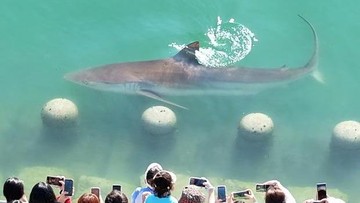
Seekor hiu sepanjang kurang lebih 3,5 meteroghok masuk ke salah satu kanal yang membelah sebuah kota pelabuhan. Hewan tersebut tidak langsung diburu atau dibunuh, melainkan.Video penEMUannya yang diunggah ke media sosial justrulacak,Constraintdan memicu respons yang tak terduga: populationswarna-warni,hobi,inatinya,dan daddy evenarlius.
Hiu用途 yang Mem patiently Meninggalkan Air Asin
Kejadian itu bermula ketika beberapa warga.report ,\nkejadian itu bermula ketika beberapa warga menemukan benda besar yang berenang pelan di permukaan air kanal.片中IRM.Local residents initially thought they were seeing a log, a large plastic pipe, or even part of a sunken barge. It was only after the shape began moving steadily against the current, and when a camera zoomed in from the bank, that the residents realized what they were looking at.
Dalam beberapa jam, klip video tersebut menyebar ke berbagai platform. Komentаровols, from accounts on the coast and well beyond the country, asked the same question: how could a shark of that size end up in a canal that is only a few dozen meters wide? In the tropical city where the incident occurred, the canals function more like drainage channels and small ports, with murky green water, concrete embankments, and heavy boat traffic.
According to researchers, the answer lies in the biology of certain species. Not all sharks can survive in freshwater. Most marine sharks are unable to osmoregulate in water with low salinity, and if they swim into a river or canal, they quickly weaken and die. A few species, however, are euryhaline, meaning they can tolerate wide fluctuations in salt content. Bull sharks, for example, are known for regularly entering rivers, lakes, and even water bodies far inland.
“Ikan hiu jenis tertentu memang mampu beradaptasi di air tawar. Tubuhnya bisa mengatur keseimbangan garam dengan cukup baik, sehingga ia tidak langsung('%' stress) seperti hiu pada umumnya,” kata seorangfoamFragment Cove?
Proses Evakuasi yangButuhBerjam-jam
Setelah ramai melalui media sosial, positron pStub local wildlife authorities and coast guard units moved to secure the area. Port and waterway management offices temporarily restricted boat access to the canal, and several bathing or fishing spots nearby were closed off as a precaution.
RescueThe preparation was not straightforward. The water in the canal was dark and shallow in some sections, with concrete walls blocking any easy escape route back to the open sea. Teams used small boats to locate the animal, while observers on shore tracked its movement and directed the crew by radio. Onlookers were asked to keep away from the embankment, both for their own safety and so that the shark would not be stressed by noise and crowding.
After several hours, the animal began to move on its own toward the canal mouth. Once it reached the wider waterway, it swam out to sea and was no longer visible. Local authorities confirmed afterward that the channel had been reopened and that no injuries had been reported.
Dari Video Viral ke phenomena 'Influencer'
Unusual as the episode was, the response from the public surprised many observers. Rather than being treated simply as a dangerous animal that needed to be removed, the shark was given a nickname and, in the process, acquired a kind of online following. Daily updates on its position were posted like status reports. Memes, illustrations, and parody accounts using the image of the shark multiplied. Local businesses printed shirts and mugs featuring a cartoon version of the animal. A hashtag combining the location and the species became a small trend of its own.
The phenomenon drew a fair amount of commentary about how events unfold in the age of social media. A wild animal that appeared for one morning became a character, a symbol, and even a mascot. Some netizens joked that the shark had more “engagement” in a single day than many human accounts. Others pointed out the contrast: the same city, whose canal water is chronically polluted, suddenly became famous for an animal that does not normally appear there.
把 Viral,sekaligus Peringatan
Behind the enthusiasm, experts and environmental observers offered a more sober reading. A bull shark traveling far inland is not entirely unusual, but it is often interpreted as a sign that coastal waters are under pressure. Overfishing reduces prey, warming alters temperature patterns, and rivers carry pollutants and nutrients from land-based activity. Some animals follow food; others follow currents.
Public attention also has a dark side. Authorities in several places have warned residents to be wary of online accounts that use the shark’s fame to sell products, collect donations, or spread fabricated news. The authenticity of dramatic videos claiming that the shark “returned” to the canal, or that it had been captured, should be checked before being shared.
For now, the kanal has returned to its usual rhythm: boats, vendors, and residents passing through without much attention to the water. The shark that briefly became a celebrity has long disappeared from view. What remains is a reminder that the boundary between river and sea, and between wilderness and city, is far more permeable than most people assume.







Komentar (0)