
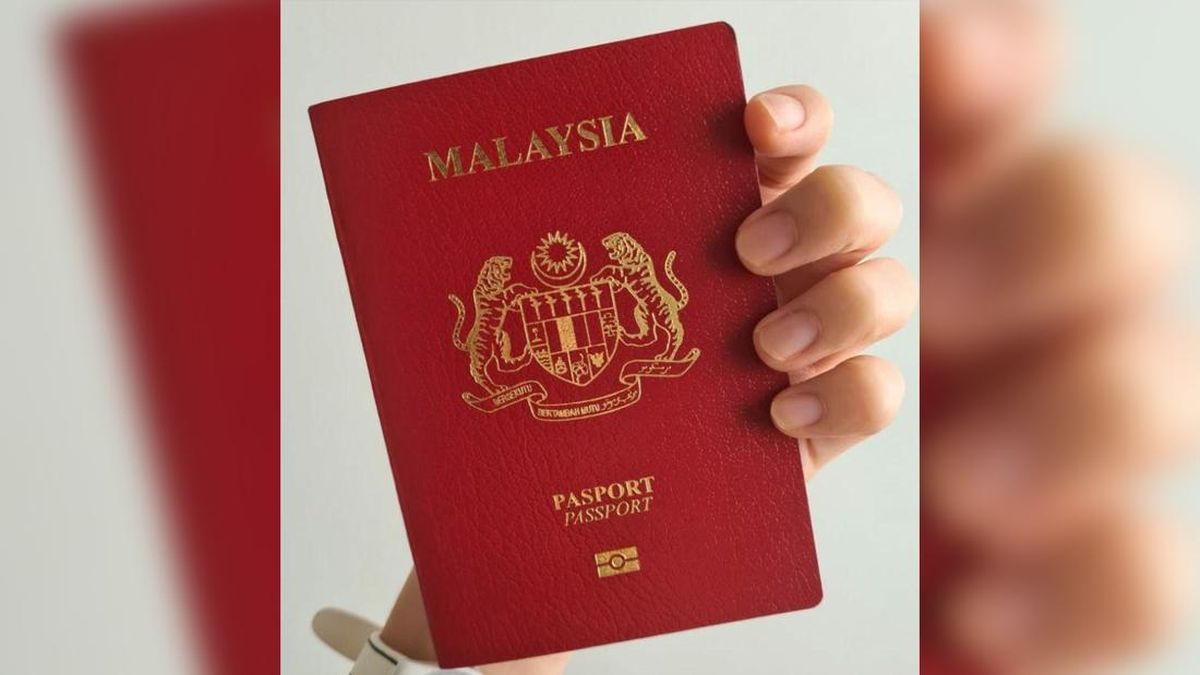
Malaysia Placement — Drew attention — Placing Malaysia's passport among the world's most powerful documents is at odds with the country's reputation, particularly in the eyes of many Indonesian citizens who frequently travel to the neighboring country. The passport, which serves as one of the most widely accepted travel documents in Southeast Asia, is reported to occupy the second position in the world in a recent international passport ranking. In stark contrast, Indonesia is left trailing far behind at the 56th position, placing it in the middle group of countries whose citizens still need to apply in advance for entry permits to many destinations.
For ordinary citizens on both sides of the border, the gap is easy to feel. Every year, millions of Indonesians cross into Malaysia, Singapore, and Thailand as tourists, workers, or pilgrims, and every trip requires advance processing: an online visa application, supporting documents, proof of return tickets, and sometimes proof of hotel bookings. Malaysian passport holders, by contrast, can visit a far longer list of countries without applying for a visa in advance, and can often enter simply by showing a biometric passport at the immigration counter.
Why Malaysia's Passport Ranks Near the Top
The ranking is generally attributed to three main factors. The first is the sheer breadth of visa-free and visa-on-arrival access. Malaysian passport holders reportedly enjoy unrestricted or easier entry into well over 180 destinations, including the entire European Union, the United Kingdom, the United States, Canada, Australia, New Zealand, Japan, and China, where Malaysia currently benefits from a unilateral visa-free policy for a specified period.
Freedom of Movement Within ASEAN
The second factor is the freedom of movement enjoyed by Malaysian citizens within the Association of Southeast Asian Nations. Agreement on the ASEAN Economic Community grants citizens of member states the right to enter and stay in any other member country without a visa or additional permit. For a country of roughly 34 million people, this translates into a passport that is effectively valid across much of Southeast Asia, a region that Indonesia has long regarded as its most important sphere of economic and political activity.
Biometric Document and Infrastructure
The third factor is the physical and digital quality of the document itself. Malaysia issues electronic passports containing a chip that stores biometric data, including the holder's facial image and fingerprints. The country has also steadily expanded automated border control lanes at major entry points, including Kuala Lumpur International Airport, which shortens processing time for arriving Malaysian citizens. In the eyes of ranking institutions, a passport scores not only on the number of destinations opened, but also on the reliability of border systems and the ease with which the document is verified.
Indonesia at Number 56
Indonesia's position, in the 56th place, reflects a different set of conditions. The country has made measurable progress over the past decade, expanding visa-free access for foreign tourists while also extending visa-free entry schemes to a growing number of Southeast Asian countries. The e-passport issued since 2011 has also improved the quality of the document, yet a substantial number of Indonesian citizens still require a visa in advance to visit major destinations.
For citizens traveling to Europe, the United States, or Japan, for example, the visa application process typically involves a consular interview, financial proof, and processing fees, with approval times that can stretch to several weeks. This creates a practical asymmetry that is frequently discussed among travelers: two citizens of the same region, departing from neighboring capitals with similar levels of income, may face vastly different entry formalities.
Diplomatic and Economic Context
Observers note that passport strength is not only a product of consular policy but also of a country's negotiating position, economic size, and diplomatic network. Malaysia, with a population of comparable magnitude to Indonesia and a per capita income that is far lower, has pursued an outward-facing tourism and investment strategy for decades, treating easy entry as a competitive asset. Indonesia, with a much larger domestic market and greater economic weight, has historically focused more on securing market access and investment commitments than on maximizing the mobility of its citizens.
That focus is now shifting. The Indonesian government has repeatedly stated its intention to ease travel for its citizens, including discussions on expanding visa-free arrangements with China, extending the validity period of the e-pasport to ten years, and broadening the list of countries eligible for the e-VOA facility, which currently covers more than 60 nationalities.
A Word of Caution on Rankings
Passport rankings are not uniform. Different index providers apply different methodologies, weighting visa-free access, visa-on-arrival availability, ease of obtaining a visa, and the number of destinations differently. Several of the world's most commonly cited indices have placed Singapore, Japan, South Korea, Germany, and Switzerland above Malaysia at various points in recent years, while others have placed Malaysia very close to the top. Rankings also shift from year to year, depending on temporary bilateral policies and unilateral decisions by individual countries.
Even so, the underlying picture remains clear: the two countries have a substantial gap in travel convenience, with Malaysia enjoying far easier entry into a far wider set of destinations. The issue is expected to remain a topic of public debate in both capitals, particularly as regional citizens compare the costs, queues, and paperwork involved in planning a trip abroad.







Komentar (0)