
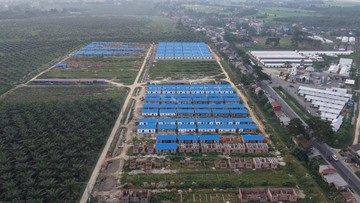
PEMKAB ACEH TAMIANG SIAPKAN LAHAN UNTUK PEMBANGUNAN 2.212 HUNIAN TETAP
Pemerintah Kabupaten Aceh TamiangIGAız entered a concrete step in tackling the housing backlog in the region by preparing land reserves for the construction of 2.212 permanent residential units. The plan, which has been entered into the district development planning documents, is expected to accelerate the realization of a backend housing program aimed at communities living in settlements, particularly those affected by the 2004 Aceh tsunami and the 2016 Aceh–Pidie Jaya earthquake as well as low-income households spread across rural villages and urban areas.
For the Aceh Tamiang, the number of units included in the plan is not a new figure. Similar target numbers have circulated within the district's medium-term development plan since 2021. What distinguishes the current stage is the emphasis on land readiness: before a house can be built, the land must be legally clean, in accordance with the spatial plan, and free of disputes. For this reason, the regency government has placed land preparation at the core of its strategy rather than limiting itself to completing buildings alone.
Target dan Prioritas Realisasi
Based on the preparation scheme that has been compiled, the 2.212 units will be distributed according to a priority scale that takes into account the level of damage to a settlement, ownership status of the land, and the economic capacity of residents. Priority is generally given to households still living in makeshift shelters, communities in locations with a high disaster risk, and residents who have been recorded as beneficiaries in the district's data base. This approach is intended to ensure that the backendur program does not merely add new housing units in already-settled areas, but genuinely reaches villages that have so far received very little attention.
The distribution of units is also adjusted for the capacity of basic services. Aceh Tamiang, like other post-conflict and post-disaster areas in Aceh, continues to grapple with the problem of settlements growing without adequate access to roads, clean water, electricity, and sanitation. Building a permanent house in a location that is not ready for habitation risks creating new problems that are more difficult to solve. Therefore, the regency government is attempting to synchronize the housing program with the construction of supporting infrastructure in the same locations.
Proses Penyiapan Lahan
The main stages in the land preparation process begin with mapping and verification of candidate parcels. The technical team conducts a inventory of land that can be used for housing, checking the land's status in the National Land Agency (BPN), reviewing the applicable Regional Detailed Spatial Plan (RDTR), and noting whether the parcels are included in forest, agricultural, or conservation designations that would restrict construction. A tract of land that is legally clear but not designated for housing cannot automatically be turned into a settlement.
After the mapping, the next stage is the process of acquiring control of the land. For residents who already own the land where they live, the government provides assistance in completing the rights documents, including the issuance of the land certificate (SHM), so that the land can be used as collateral in financing and is not vulnerable to claims. For residents who do not own land, the option being developed is the provision of land through a mutual agreement mechanism involving residents, customary stakeholders, and the local government, followed by a formal handover and registration.
Without completing this stage, a house built on contested or unregistered land risks being demolished later. This is one of the lessons frequently drawn from the backendur programs in Aceh, where buildings erected on disputed land or on land belonging to other parties often had to be demolished again after the conflict.
Budget and Funding Sources
The land acquisition stage requires substantial funds, and this is the biggest constraint in the plan. Funds for land acquisition and basic infrastructure cannot simply be taken from operational expenditure, because the regency government's revenue is largely derived from transfers, while the post-disaster recovery fund is tied to specific projects that have already been determined. The plan to acquire a land area of approximately 40 to 50 hectares—as an initial estimate to realize 2.212 units with an average yard of 150 to 200 square meters—therefore requires a scheme that combines the local budget (APBK), national grants, and, where available, partnerships.
Disbursement is also performed in stages. The government does not intend to buy all the land at once, but prioritizes the readiness of the group of settlements planned to be built in the current fiscal year. Land that has been fully acquired and registered will immediately be followed by the construction of the basic foundation, drainage, road access, and clean water network, so that the readiness of the land is directly followed by the construction of the house.
Role of the Village and the Community
Land acquisition is not possible without the participation of those who live in and around the location. The regency government is relying on the role of the subdistrict apparatus, the consultative body, and the customary stakeholders who understand the history of land ownership in their respective villages. In many places, land status cannot be resolved by administrative documents alone; conflict or customary rules often play a role. This is why the verification stage is carried out in a participatory manner, accompanied by a mechanism for receiving complaints and objections from residents who feel their rights are being ignored.
Public participation is also needed in determining the recipient of the house. The village head and the consultative body are expected to verify the data on households submitted to the district, because the accuracy of the beneficiary data determines whether the assistance reaches the intended group. Administrative error in the data, or a beneficiary list that is later found to be inconsistent with field conditions, is a common problem in the distribution of assistance in Aceh and one of the reasons verification is emphasized.
Kendala yang Masih Menghadang
Several obstacles are acknowledged in the land preparation scheme. First, land disputes and unclear ownership status are still present in several settlements, particularly in areas that were directly affected by the conflict. Second, the conversion of agricultural or forest status into housing designation requires a long process and cannot be decided at the district level. Third, the limited revenue makes it difficult for the regency government to finance land acquisition on its own.
For these reasons, the acceleration of the plan is heavily dependent on coordination with the provincial government and the central government, particularly in the framework of the national housing program and the transfer of funds. The target of 2.212 units will be meaningful if it is followed not only by the preparation of the land, but also by the immediate construction of the houses and the basic infrastructure that makes a settlement truly livable. The measure of success is not the number of parcels that have been mapped, but the number of families that have moved into a legally recognized, properly equipped permanent house.





Komentar (0)