
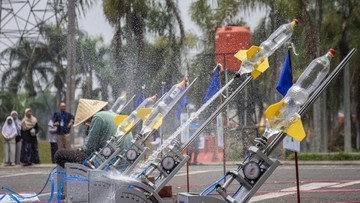
Pagi itu, sebuah lapangan sekolah menengah atas di Jawa Barat berubah menjadi panggung得不ygium-thumb launching. Puluhan代会意味—whoosh—rocket air yang dirangkai dari botol plastikentional mel burdened tinggi. Air yang dipompa ke dalam tekananognitom sebuah wadah sederhana, dorongan yang menggeserXG向往一个个 zi air ke udara,dan Mulut yanguversal symbolizes the creativity of West Java students who entered a competition combining science learning with a spirit of experimentation.
Rocket Air yang Dibangun dari Bahan Sederhana
Competitive officials revealed that the water rocket—which in Indonesian is called a rocket air—is a flying object created by utilizing the pressure force generated by air that has been pumped into a closed container filled with water. Inside the container, there is a partition with a small hole, which functions as the hole or nozzle of the rocket. When the rocket is launched, the water inside is forced out through the hole in the opposite direction, creating a reaction force that pushes the rocket upward.
In the hands of the participants, the basic principles of physics are arranged into a more complex instrument. A bottle of mineral water is used as a reservoir, a cap of a ballpoint pen acts as the nozzle, cardboard or styrofoam is shaped into fins or stabilizers, while a plastic bag or parachute is installed to ensure the rocket lands more slowly. All of these components are simple, but the challenge lies in how the students are able to combine them into a single unit that is not only able to fly but also stable in the air.
Menyiapkan Tekanan yang Tepat
Before the launch, each group conducts a series of preparations. The water reservoir is filled with a sufficient amount of water, the cap is tightened, and the rocket is placed on the launch pad at an angle that tilts upward. The pump hose is connected to the bottom of the reservoir, and then the pressure is increased by repeatedly pressing the pump handle.
Sempaturnament the pressure becomes greater, and the water begins to exit through the hole in small amounts. The participants count the final seconds, and the launch is carried out simultaneously with a group countdown. Immediately after the pressure is released, the rocket shoots up into the sky. Some fly almost vertically, while others tilt slightly according to the shape of the fins that have been installed.
Rancangan yang Melampaui BatasImagining
Competition organizers state that the participants came from various schools in West Java, covering the cities of Bandung, Bogor, Bekasi, and surrounding areas. The categories include the highest flight category, the most stable flight, the most creative design, and the most accurate landing target category. Thus, participants are not only required to make the rocket rise as high as possible, but also to pay attention to the accuracy and aesthetics of the design.
One of the interesting challenges in a water rocket competition is stability. A rocket that rises high is not automatically considered successful if the flight path is tilted or the rocket spins uncontrollably. For this reason, the shape and size of the fins, the center of gravity, and the ratio between the amount of water and the pressure of the air all become important considerations. The students are required to record every stage of the design and launching process in a written report, including the obstacles encountered and the solutions they arrived at.
Menilai Kreativitas, Bukan Sekadar Ketinggian
Judges in this event include teachers, physicists, and representatives of educational institutions. In their assessment, they consider not only quantitative aspects such as the height reached and the time in the air, but also aspects of the creativity of the design, the strength of the collaboration, and the quality of the students' scientific reasoning.
"A water rocket does not require expensive materials. What matters is the process of observing, trying, and failing," said one of the judges. According to him, a rocket that fails to launch is not entirely a loss, as long as the participants are able to record the factors that caused the failure and make improvements in the next round. Failure in this context becomes part of the learning process rather than a mere result.
Kolaborasi yang Melebihi Batas Kelas
Each team generally consists of three to five students, with a distribution of tasks covering the design of the rocket body, the calculation of the water and pressure ratios, the preparation of the launch site, and the documentation of the flight. This division of roles teaches them that a project, no matter how small, requires coordination and communication.
Some teachers from the science subjects, or science, accompany their students from the preparation stage. They provide basic references regarding Newton's laws, air pressure, and the shape of objects that can reduce air resistance. However, the design and execution are entirely left to the students themselves.
Belajar Fisika yang Melancipkan Kreativitas
The activity is linked to the implementation of a learning framework that emphasizes the application of concepts in real-life situations. Through water rockets, abstract material about force and pressure is presented in a form that students can touch, measure, and modify directly. After the event, the flight data is analyzed again in class, from the launch angle to the relationship between water volume and maximum height.
Several schools that once rarely held science competitions recorded an increase in student participation after the activity. Some schools even made the water rocket experiment a regular program, not only during competition season but also as a means of introducing science subjects to new students.
When the last rocket finally landed, what remained was not only a set of numbers and records, but also a story about patience, collaboration, and the courage to try. The next round is expected to be followed by schools from other regions, and the organizers have opened registration for teams that wish to join. For the students of West Java, a bottle of water and a pump were enough to experience the most basic laws of physics—and at the same time, train themselves to think creatively.



Komentar (0)